Correction
Database table 15b5 has been corrected on 13 March 2026.
Read more about the correctionConsumer price index 2026, January
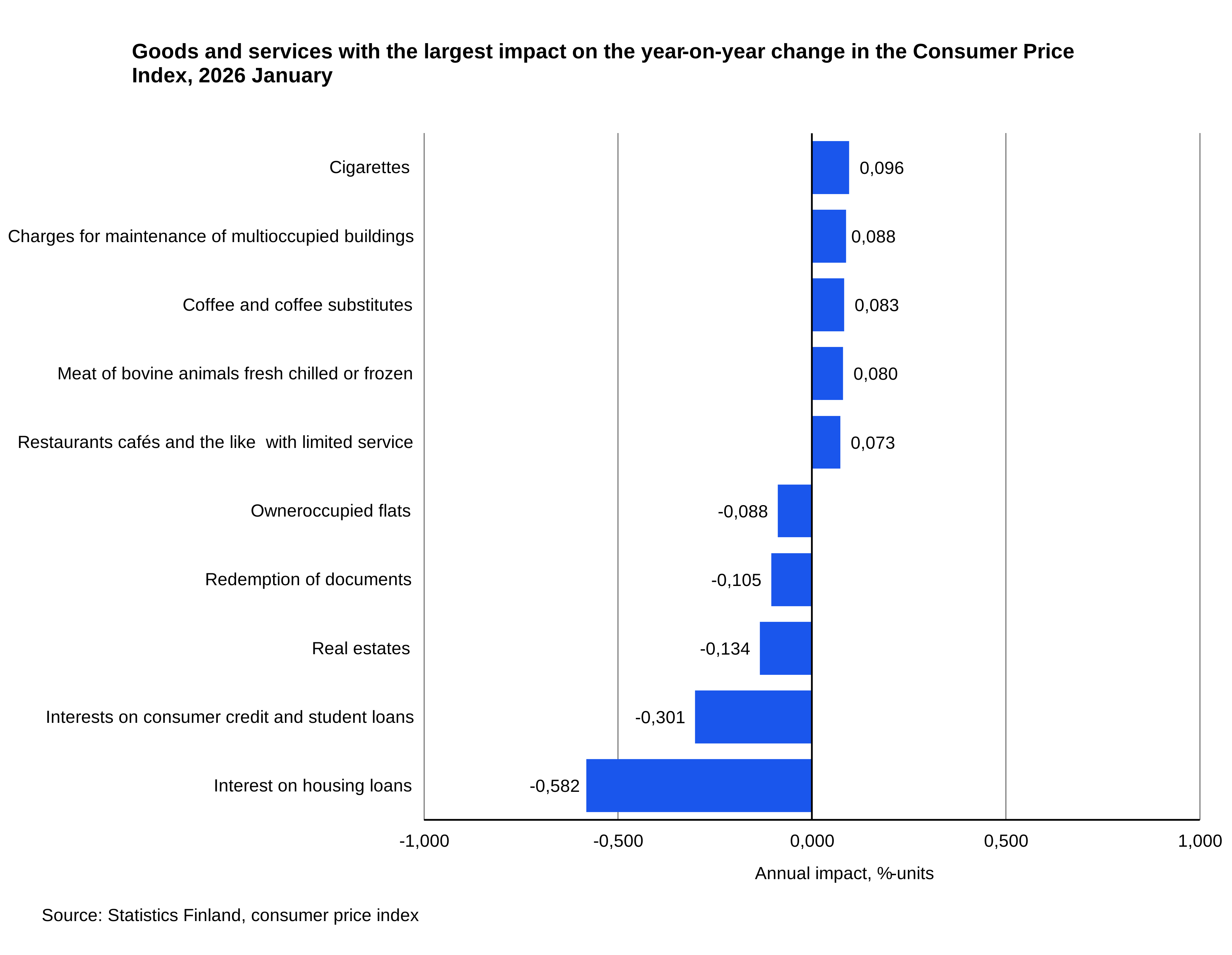
According to Statistics Finland, the year-on-year change in consumer prices was -0.2 per cent in January 2026. In December, inflation stood at 0.2 per cent. The month-on-month change of consumer prices was -0.2 per cent. In January, the commodity basket of the Consumer Price Index and the weight structure of consumption were updated corresponding to the private consumption in 2025.
Database table 15b5 has been corrected on 13 March 2026.
Read more about the correctionChanges in the consumer price index database tables starting from the publication of data for January 2026.
Read more about the changeChanges for 2026 – annual review, 19 February 2026.
Read more about the change| Point figure | Monthly change (%) | Annual change (%) | |
|---|---|---|---|
| Consumer Price Index 2025=100 | 99.78 | -0.2 | -0.2 |
| Cost-of-living Index 1951:10=100 | 2334 | ||
| Harmonised Index of Consumer Prices 2025=100 | 100.27 | -0.1 | 1.0 |
| Harmonised Index of Consumer Prices at Constant Taxes 2025=100 | 100.25 | -0.1 | 1.0 |
According to the preliminary data on the Harmonised Index of Consumer Prices (HICP), the rate of inflation in the euro area was 1.7 per cent in January. In December, it stood at 2.0 per cent. The corresponding figure for Finland was 1.0 per cent in January.
The Harmonised Index of Consumer Prices does not include owner-occupancy, interests on consumption and other credits, fire insurance on owner-occupied dwellings and the vehicle tax. The consumption items included in the Harmonised Index of Consumer Prices, as well as the rules governing its compilation, have been defined in EU regulations.
Eurostat’s estimate of inflation in the euro area is based on preliminary data from the Member States and on the price development of energy. Eurostat will publish detailed data on Harmonised Indices of Consumer Prices for January on 25 February.
The year-on-year change in the Harmonised Index of Consumer Prices (HICP) stood at 1.0 per cent in January and that in the Index at Constant Taxes (HICP-CT) measuring market inflation at 1.0 per cent. Over twelve months, the combined raising impact on consumer prices from changes in commodity tax rates was thus 0.0 percentage points. In January, the 14 per cent value added tax rate was reduced by 0.5 percentage points and the taxes on alcohol, tobacco, and fuel were changed. The month-on-month change in the Harmonised Index of Consumer Prices was -0.1 per cent and that in the Index at Constant Taxes -0.1 per cent in January.
In the Index at Constant Taxes, the impact on inflation from changes in the value added tax and other commodity taxes has been eliminated by keeping the taxes constant relative to the index base period. The Index measures market inflation or the change in prices caused by reasons other than changes in commodity taxes. The price impact of the tax changes is obtained by comparing the development of the Harmonised Index of Consumer Prices and the Index at Constant Taxes.
The data for the 2026 annual review of the Consumer Price Index can be found in the change release.
Pick the data you need into tables, view the data as graphs, or download the data for your use.
