Consumer price index: Changes for 2026 – annual review
Time of change:Consumer price index 2026, annual review, 19/02/2026
Weight structure and commodity basket of the Consumer Price Index updated for the year 2026
Statistics Finland updated the commodity basket and weight structure of the Consumer Price Index with the latest data on consumption expenditure in 2025. In the same context, the internationally revised Classification of Individual Consumption According to Purpose COICOP was adopted.
Weight structure
According to EU guidelines, the weight structure of the Consumer Price Index for 2026 is based on national accounts calculations on private consumption expenditure in 2025. Commodity-level consumption expenditure is estimated based on other sources, which include data from the Household Budget Survey for 2022, data from producers of other Official Statistics of Finland (OSF), sales data of enterprises and data of other actors.
The value of the consumption basket of the Consumer Price Index was about EUR 128 billion in 2025, having been around EUR 130 billion in 2024. Private consumption expenditure contracted by two per cent in a year.
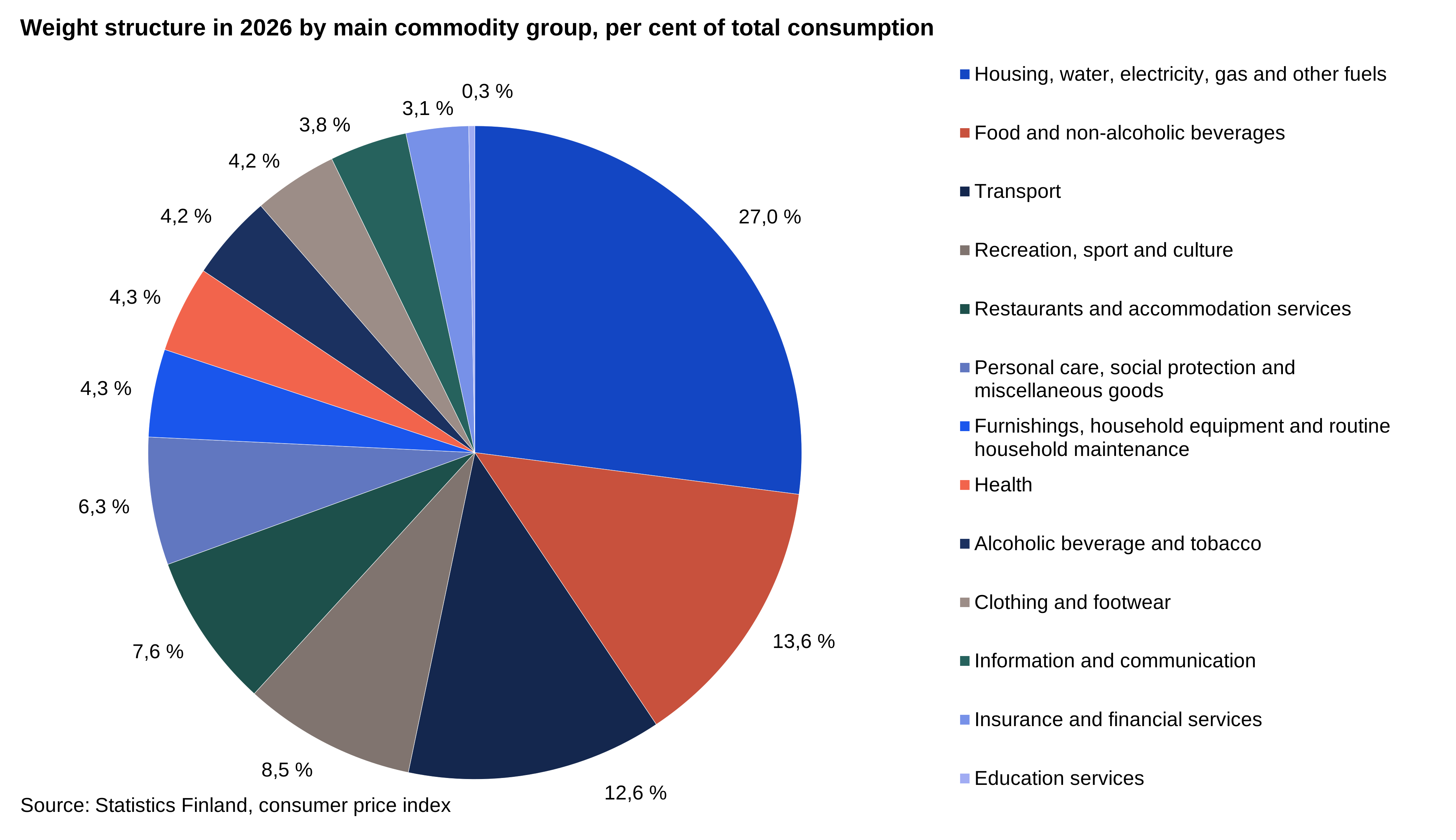
The figure below shows the distribution of the weight structure of private consumption by main commodity group for the statistical reference year 2026. The main commodity groups cover all products and services belonging to private consumption, excluding narcotic substances, prostitution and financial intermediation services indirectly measured (FISIM).
Commodity basket
The price data of the Consumer Price Index are based on a commodity basket that is updated annually along with changes taking place in consumption. At the beginning of 2026, electric car charging was added to the commodity basket. The sample was extended with taxi rides reimbursed by the Social Insurance Institution.
Due to low consumption, the following commodities were removed from the commodity basket: baby clothes and supplies, dry-cleaning of clothes, cutlery, microwave oven, painting service, medical examination and treatment fee, lubricants, folk high school course fee, hunting and fishing fee, and price monitoring of a computer game and game console.
In addition to updating the commodity sample, the content of the commodity basket is continuously updated as concerns individual products selected to the data collection.
Classification of Individual Consumption According to Purpose
The European commodity classification (eCOICOP, ver. 2, European Classification of Individual Consumption According to Purpose) was adopted at the beginning of 2026. It is based on the UN’s Classification of Individual Consumption According to Purpose.
In the European classification, the commodities are divided into 5-digit level sub-groups, by which the products and services are separated into specific commodity groups. The Finnish national classification specifies the European classification with 6-digit and 7-digit commodity groups (classification, in Finnish). The sub-division can be updated annually when new commodities are added to the commodity basket or removed from it.
Update of data collection
The price data were extended with the introduction of big data, that is, sales data of stores in the groups of small home appliances, small tools, games of chance and summer sports equipment, for example.
The data collection was reduced for a few chains of stores because on their websites they have their product supply covering the whole of Finland and the prices of products, which are in future utilised in index calculation.
Update of tax rates
Last year's the value added tax rate of 14 per cent was lowered by 0.5 percentage points for food and restaurant meals, medicines, books, public transport, and sports and cultural services.
An index adjustment corresponding to the rise in consumer prices was made to the tax levels of all alcoholic beverages for 2026, in addition to which the tax levels will in future be permanently tied to the Consumer Price Index. In other words, tax levels would rise yearly automatically in proportion to the rise in consumer prices.
In addition to index rises, a separate tax increase was made to the group of wine and other alcoholic beverages produced by fermentation (including ciders and medium-strong long drinks), which entered into force on 1 January 2626.
In addition to the above-mentioned tax changes, the tax changes were also taken into consideration in terms of the vehicle tax, tobacco tax, soft drinks tax (effective on 1 April 2026) and taxation of liquid fuels.
Weight structure of the Harmonised Index of Consumer Prices is also updated every year
Statistics Finland has also updated the weight structure of the Harmonised Index of Consumer Prices calculated for Eurostat, the Statistical Office of the European Union. Its base year is the same as that of the national Consumer Price Index, 2025=100.
The Harmonised Indices of Consumer Prices are primarily used in price comparisons between the EU countries. The European Central Bank uses the Harmonised Index of Consumer Prices as the measure of inflation in its monetary policy.
The Finnish Harmonised Index of Consumer Prices is mainly based on the same weight and price data as the national Consumer Price Index, but its commodity selection is narrower. It does not include owner-occupancy, interests and tax-like payments.
COICOP code | Commodity/commodity group | Weight in the CPI year 2025, % | Weight in the CPI year 2026, % | Change, % |
|---|---|---|---|---|
04.6 | Owner-occupied housing | 12.1 | 10.5 | -13.5 |
07.2.4.2.0.1 | Vehicle tax | 0.8 | 0.7 | -13.5 |
12.1.3.0.0.2 | Premium for fire insurance on detached house | 0.3 | 0.2 | -17.8 |
12.2.2.0.0.2 | Interest on consumer and student loans | 2.1 | 1.0 | -52.2 |
Items removed from HICP, total | 15.30 | 12.41 | -18.9 |
Further information
Kristiina Nieminen
Senior Statistician
029 551 2957